We offer human-written, curated stories for you to learn from. Our primary goal is not to show two versions of the same text next to each other (though you can do so by selecting Bilingual mode in the difficulty selection, if you wish). Instead, you choose the language you speak and that’s the language you’re going to read the tale in and we’re going to offer you an occasional word/phrase sprinkled in. You’ll never get lost or overwhelmed because you’ll simply understand what the word means from the context it is used in. And if you do get lost on occasion, hints or tooltips with translations are always available to you!
Additionally, everything you learn in our tales can then be practiced in our Exercises. They are stress-free, built entirely from the pages you’ve already read, helping carry all the new words from your short-term memory into the long-term one.
First, you select your native language (or a language you are proficient in). Select a tale that interests you. Then, select a language you wish to learn. Finally, choose a difficulty level (the Tailored Journey, our adaptive difficulty, is highly recommended) and start reading. With each new page, new lexical units will be automatically added to your vocabulary and you might not even notice the foreign words appearing because of how natural it feels to read unknown words in a known and easy-to-understand context. As you read more, you’ll realize that you’re understanding the foreign words as if you’ve known them since forever!
Quilingo helps you learn new words and phrases, understand how languages work, and keep your skills sharp. All while actually having fun. But will it make you fluent all by itself? As much as we would love to say “Of course!”, we prefer to be direct and honest. The answer is that no single app, website, or exercise can do that. Only full immersion can help you reach fluency. You need to surround yourself with the language you wish to learn – consume media in the language, try to make contact with native speakers (they may even live nearby!). Travel to the country where the language is spoken, if you can. We can’t do all that for you. But we can help you along the way.
We offer the Tailored Journey (our adaptive difficulty) or 5 preset difficulty levels. The Tailored Journey adapts to your knowledge and your lesson performance in our exercises while reading. Should you rather choose from the preset difficulty levels, the main differences between them are the number of new words added to your vocabulary per page and the maximum number of words translated per page. Lower difficulties also show original (non-translated) text in parentheses and enable highlighting of translated words by default. In any case, all these options are configurable in the settings menu so you can mix and match as you desire!
If you’re unsure which difficulty level is right for you, we recommend starting with the Tailored Journey and then adjust it if you feel the need. You can change the difficulty level in the settings menu at any time.
Of course! There’s a settings menu you can open on the tale reading page where you can change the difficulty level (be it the Tailored Journey or any of the 5 preset difficulty levels) and many other options.
At this moment, you can use Quilingo on anything that runs an up-to-date modern browser, with mobile apps coming in the future. Very old devices that no longer receive browser updates may not work properly.
For now, website only. Mobile apps are definitely something we’re planning to do, but for the moment, there’s still a lot of other work to be done.
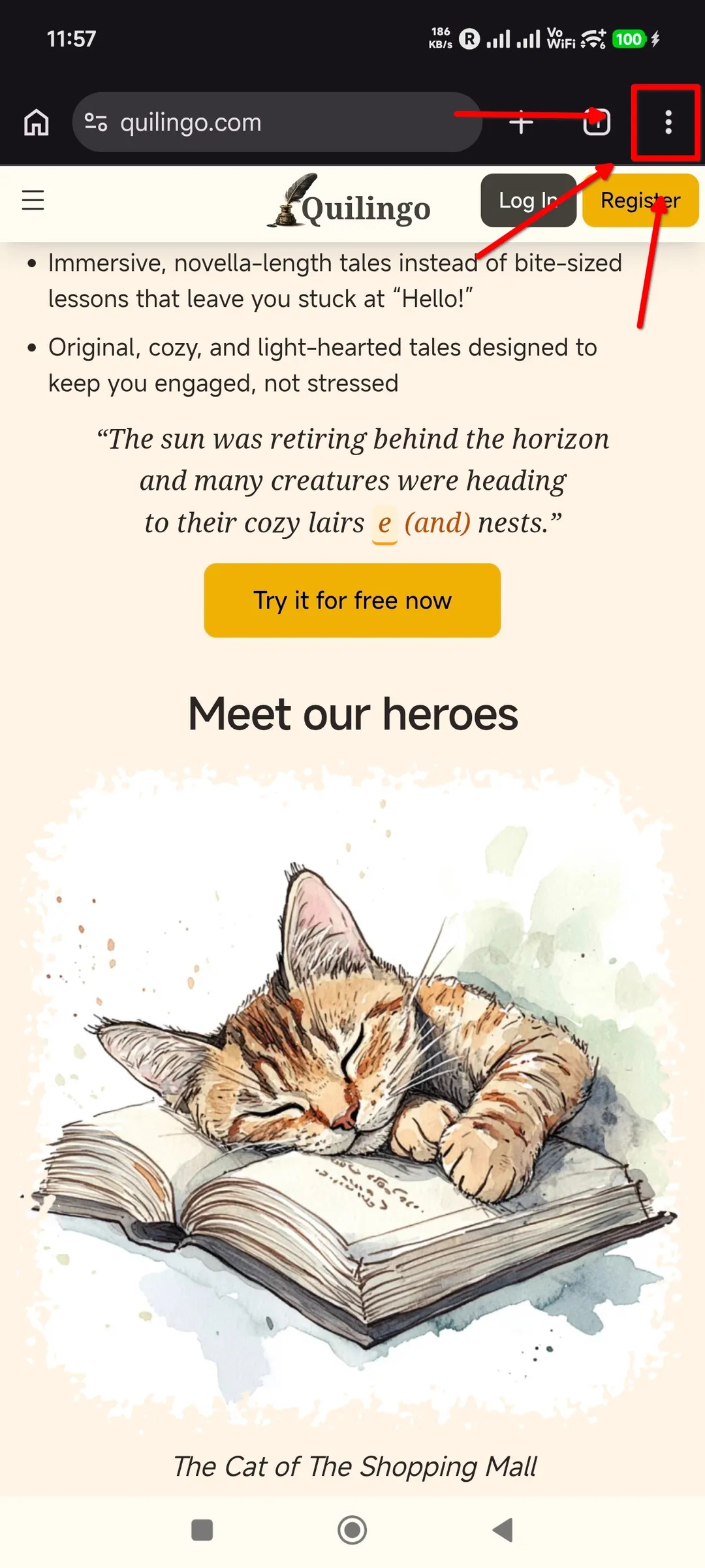
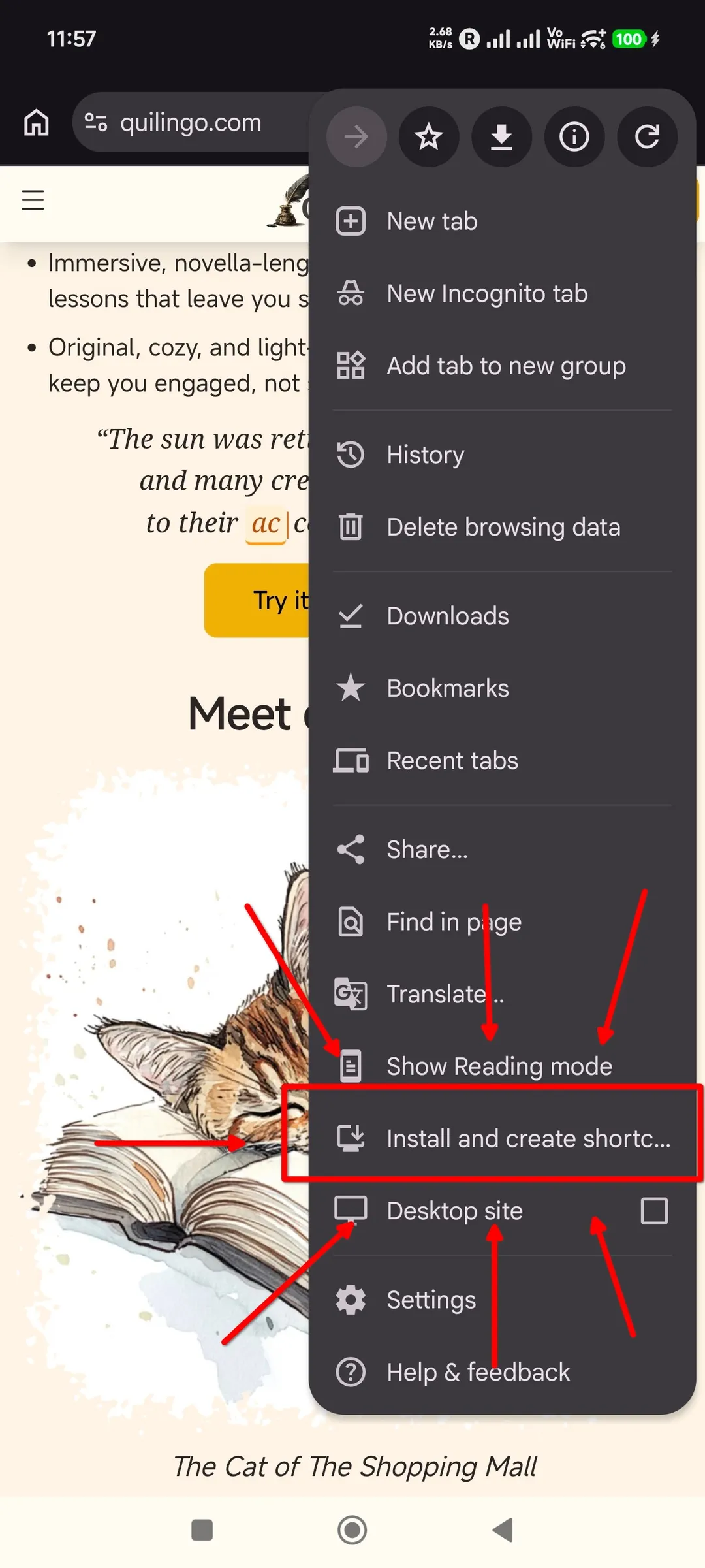
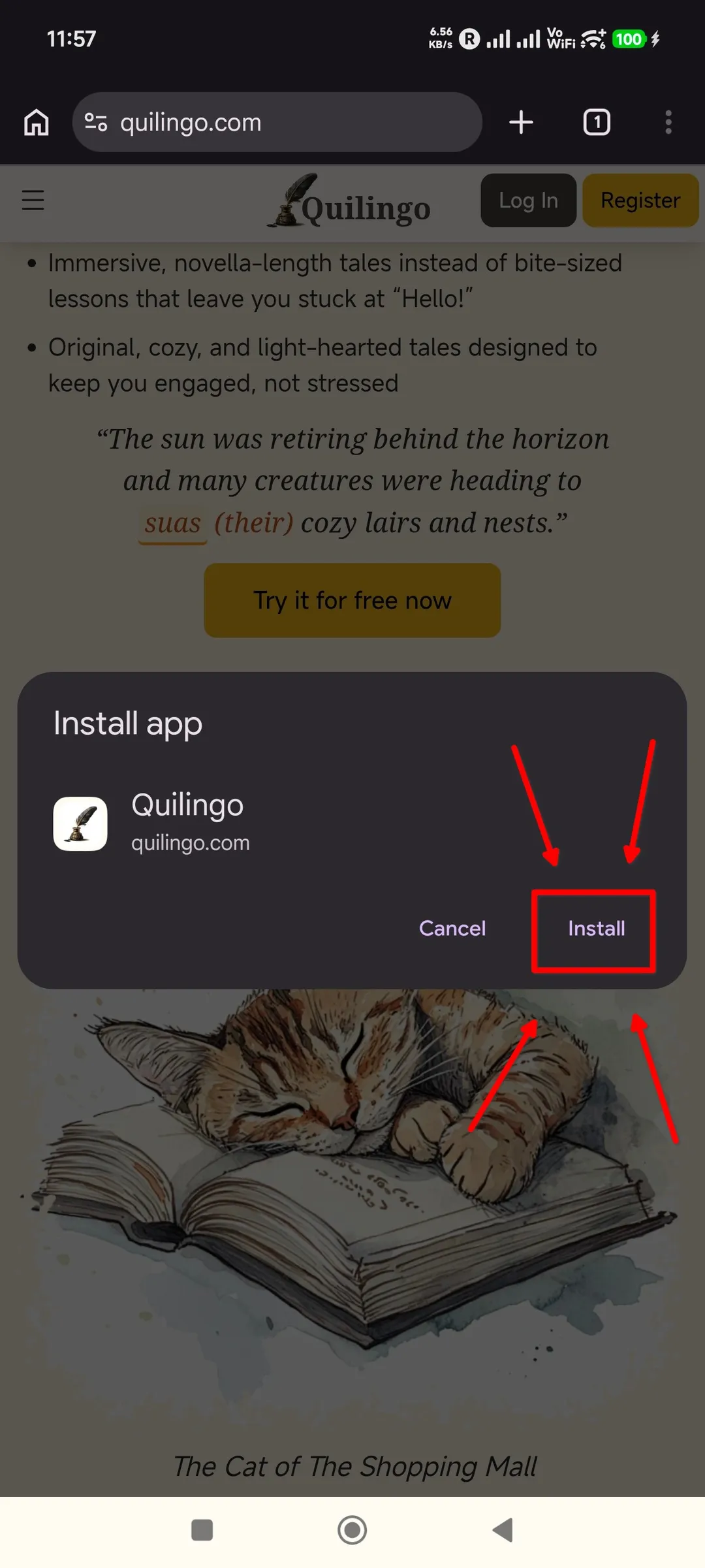
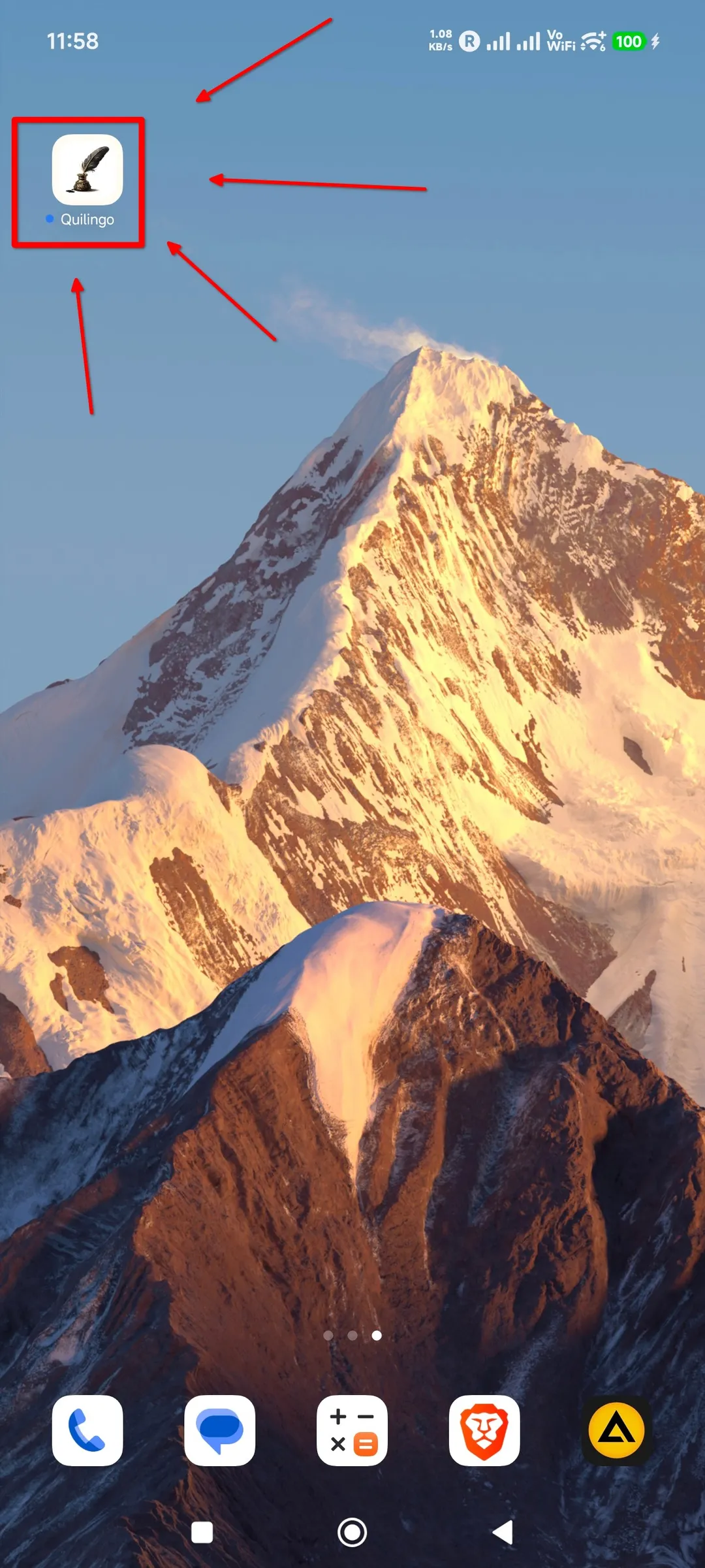
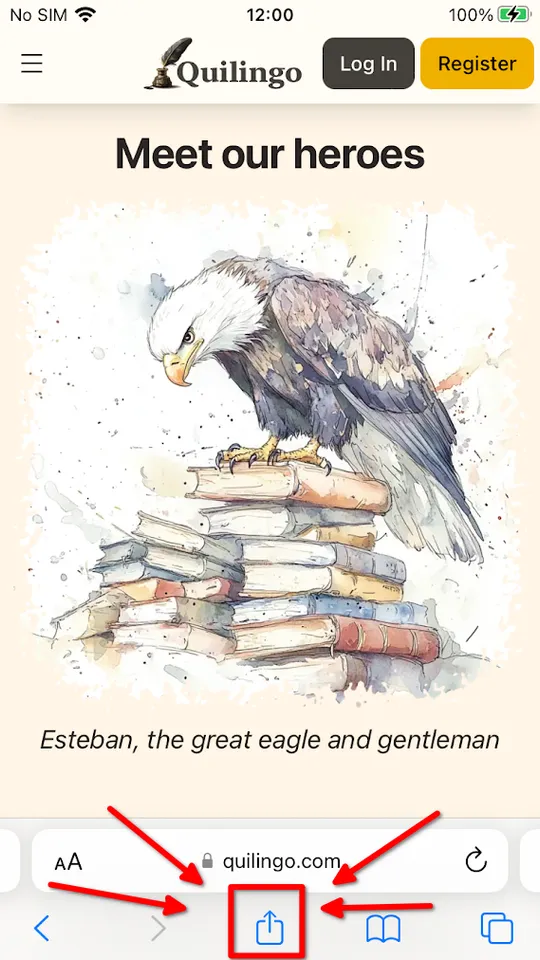
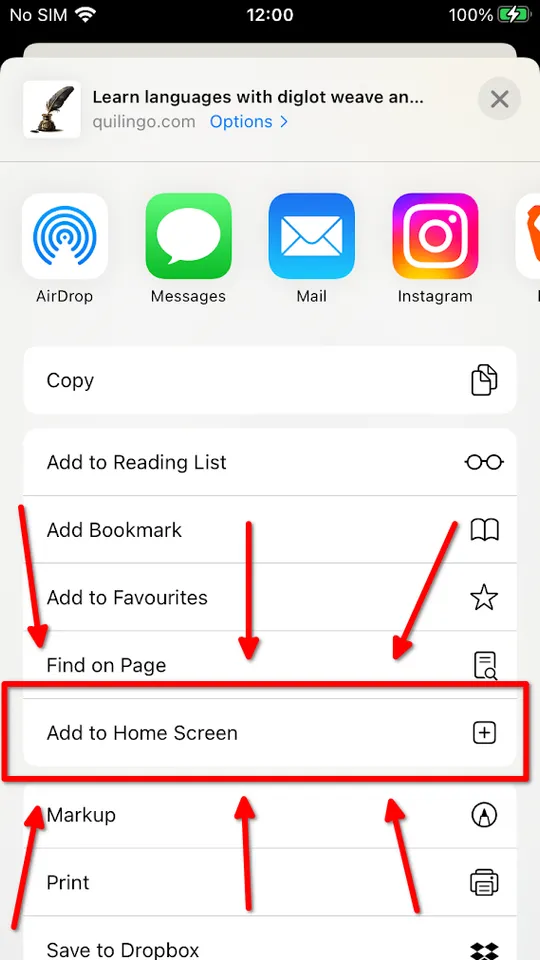
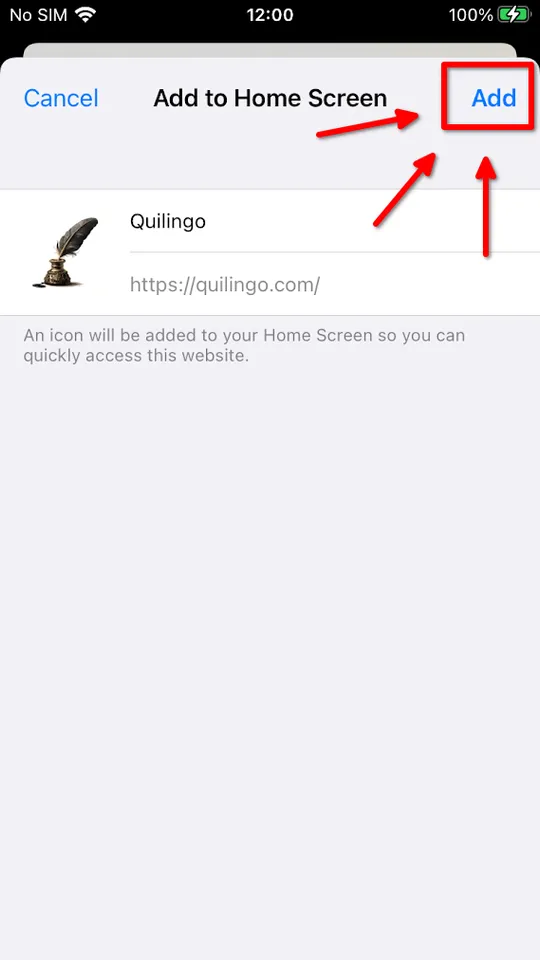
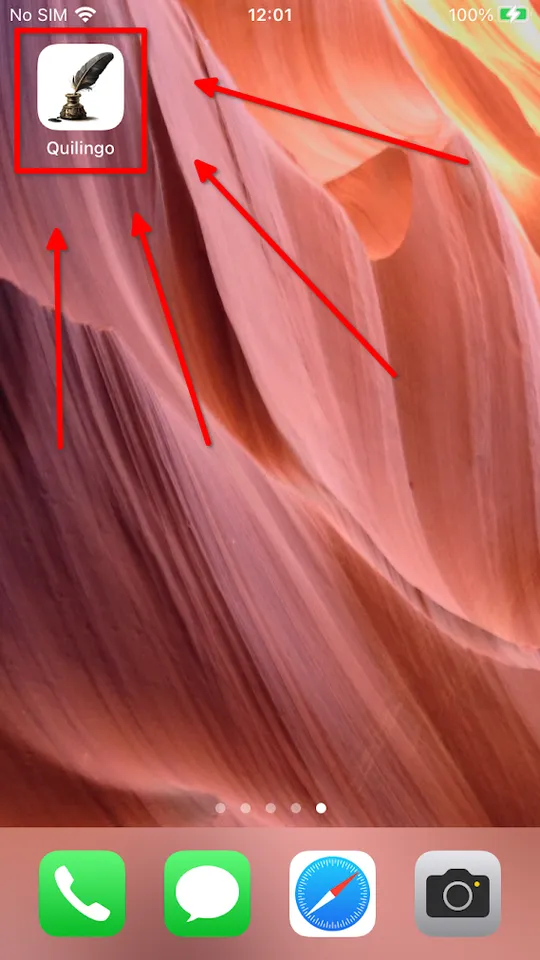
In the meantime, you can add Quilingo to your home screen, where it looks and behaves much like an app — one tap and you’re back on your bookshelf. Here’s how:
On Android
1. Open the browser menu2. Tap “Install and create shortcut”3. Confirm with “Install”4. Quilingo is on your home screen!
On iPhone/iPad
1. Tap the share button2. Tap “Add to Home Screen”3. Confirm with “Add”4. Quilingo is on your home screen!
Currently, reading our stories requires an active internet connection. There are too many parts (such as our lexical unit selection algorithm) currently existing only in our backend code and our stories living only in our database. While we would love to make our website available for those situations with bad reception or long-haul flights, for example, it would require a big architectural overhaul that we might do one day, but it currently isn’t our priority.
Human language, while it does consist of words as building blocks, doesn’t rely strictly on words. There are many phrases (often called idioms) we use on a daily basis that consist of multiple words, which together carry a different meaning than they do standalone. Additionally, what we may say in one language with three to four words can be said in another language with only one. That is why, in context, focusing solely on words is often not the best way to study and decode language.
Our main guiding principle was to break down the text into the smallest lexical units possible while preserving the intended meaning.
Of course! You can find all of them in your Vocabulary, together with examples of their use in context from stories you’ve already read.
Our tales
At the moment we offer Castilian Spanish (also known as European or Peninsular Spanish), Brazilian Portuguese, Russian, and English. More specifically, we offer the following language pairs:
English ➞ Castilian Spanish
English ➞ Brazilian Portuguese
English ➞ Russian
Castilian Spanish ➞ English
Brazilian Portuguese ➞ English
Russian ➞ English
If you didn’t find the language pair you were looking for, don’t worry as we’re always actively working on adding more languages and language pairs. Any new additions are always announced on our blog in the “Newly bound” category of articles and in announcement emails sent out to registered users opted in to marketing communications. And sometimes, we even release stuff before writing articles and sending out emails, so feel free to browse our bookshelves anytime.
We always aim to strike a balance so that our texts aren’t so simplistic that they become too boring, too easy, or even offensive to readers’ intelligence, while also not too academic or literary to make it difficult and confusing. On average, we would say that the level of language in our fully translated tales is somewhere around B1 and B2 levels. But don’t worry, even if you’re a complete novice, our method of learning will introduce you to a new language at a leisurely pace.
The ramp-up of new words added to your vocabulary is slow enough not to become overwhelming and you can always level up to the Tolkiens and Dostoevskys, should you desire to do so.
We appreciate the direct question and we’re happy to answer that no, our tales are not AI-generated.
All our stories are human-written because we believe that LLMs, while an excellent tool for various daily tasks, are not capable of writing compelling, engaging, fun stories. And definitely not stories longer than a few pages at most without an insane amount of handholding to mitigate their hallucinations and their tendency to simply forget what was written earlier.
But we’re quite happy with the quality of our writing, and therefore didn’t feel the need to use them, so ¯\_(ツ)_/¯
Although one of us is a very talented painter, considering the amount of work required to get all the text into the required shape, the time necessary, and a tight budget, we opted to go the faster and less costly route and generate images with Midjourney. That said, considering the images are not supposed to be the main attraction of Quilingo but rather a mood setter, we hope you still like them.
The second part of Quilingo that is AI-generated is the audio pronunciation. We use Google’s Gemini 3.1 Flash TTS model to generate the audio for all our lexical units to make listening and pronunciation practice possible.
That’s completely understandable and we agree with you. We aim for something not too long that it bores you to death, while also not too short for any story development to happen.
Each of our stories is somewhere between 40,000 and 55,000 words long on average, which in literary terms is something between a novella and a short novel.
For comparison, that’s about the length of:
- The Hitchhiker’s Guide to the Galaxy by Douglas Adams
- The Alchemist by Paulo Coelho
- half of Harry Potter and the Philosopher’s Stone (the first Harry Potter book)
- a quarter of The Fellowship of the Ring (the first Lord of the Rings book)
- about 3–4 chapters (or about 15%) of the Game of Thrones book (the first book of the A Song of Ice and Fire saga)
We consider Google Translate to be quite terrible, so we don’t use that.
As for the AI – while LLMs have made a remarkable leap in recent years and are capable of producing very good translations, they’re often still not capable of getting the nuance and small details of literary text. For this reason, we’ve teamed up with experienced and meticulous human translators (native speakers) who have provided us with translations we needed. The only place where we might use AI translation in the future is purely informative text on the website, unrelated to the stories themselves.
This is absolutely not it! As for content, we absolutely do plan to bring in more tales and languages (though that process is unfortunately very slow and quite pricey), but also features on the website such as improved UI, improved information about each word, mobile apps (both iOS and Android), text-to-speech for you to listen to, better gamification (achievements, collectibles! maybe leaderboards?), and more to make the learning even more fun.
Ouch, that hurts but it’s fair. We’re trying our best but to be frank, writing the stories, editing, proofreading, translating, and making them work with our system is a very laborious, long, and slow process. We hope that we can speed things up in the near future but for the time being, we hope to introduce a new translation of a story at least every 1.5–2 months.
We’re sorry to hear that, but it’s possible. Even the Lord of the Rings books went through numerous revisions for many decades.
That said, there may be an explanation why this is happening – many translations between languages simply do not go one-to-one. What in one language might be a sentence consisting of two nouns, at least one adjective, and a verb may be only a single adverb in the other language. While this would make for the most natural or colloquial translation, it wouldn’t necessarily make for a smooth learning experience teaching individual words and phrases. Instead, it would result in what’s essentially a travel phrasebook.
Because of this, there was a careful balance to be struck between “what would a native speaker say” vs “maybe on the literary end but still correct while preserving most words resulting in better vocabulary additions with higher pedagogical value” for us to find with each translation.
But, if you consider a certain translation way too off for this to be the case, absolutely don’t hesitate to reach out to us through our “Report an issue” contact form or directly at our email address contact@quilingo.com
We’re always working on expanding our inventory of tales and languages. If we don’t offer your desired language yet, we will likely offer it at some point in the future.
Adventure, mysteries, funny animals. Our aim was to produce stories that don’t require a significant amount of mental capacity to read (language learning is taxing enough already) while not being overly simple, which would make them dull and boring.
We certainly do think so. That said, there are some topics that might not be easy to understand for younger audiences.
As fast as we can. We don’t wish to give a specific timeframe that could be held against us if we don’t deliver due to unforeseen circumstances, but trust us when we say that we’re trying to work as fast as we can without compromising quality. And whenever a new tale is fully ready, you’ll find its proper introduction in a “Newly bound” article on our blog and in announcement emails sent out to registered users opted in to marketing communications. At times, we release some tales before the announcement when all the languages aren’t ready yet, so always keep an eye on our bookshelves.
It is our aim to always have all the stories available in all languages. That said, it requires a tremendous amount of work with text, editing, proofreading, categorization etc., so if we, for example, add a new tale, it may take us a bit of time to have it available in all the other languages.
Pricing & subscription
As much as we would love to provide everything for free, there are significant costs behind bringing you the content, such as the work of our proofreaders and translators, development costs, hosting, and other costs.
We offer a free trial for all tales up to 7 pages (1 page is about 750 characters, including punctuation, which is around 100 words per page) to try and see what we’re about. Then, if you like our stories and our method of learning, you can subscribe to continue reading!
No time limit. No need to register for the free trial. Just open a tale and start reading. No commitment. We don’t even ask for your email address!
Nope! Just pick your known and target language and a tale you wish to read, select a difficulty level (the Tailored Journey, our adaptive difficulty, is highly recommended), and you can start learning!
Everything up to page 7, including all the features we have to offer at the moment (such as vocabulary and exercises). All the content past page 7 is only for subscribed users.
While we would love to offer everything for free, the sad truth is that however much we love what we’re doing, it’s expensive. We need to pay for programming (maintenance when something breaks and new features), writing new stories, proofreading, website hosting, CDN hosting, database hosting, DDoS protection, and believe it or not, those are the smaller parts of our budget. The most expensive parts are the translations, their quality control and then someone needs to pair lexical units between languages and that someone needs to be familiar with those languages. It is a slow, laborious process requiring a lot of time, effort, and experience.
We will be more than happy should you decide to support us so we can bring you a better experience, more features, and mainly more tales and more languages for you to learn!
Absolutely not! A flat fee of 6 EUR gives you access to all our content and features. There are no hidden surcharges, microtransactions, or dark patterns lurking in the shadows to sneak up on you and pounce as you lower your guard. We despise nickel-and-diming and therefore won’t do it.
Yes. You can cancel your subscription at any time in your Account settings. Your subscription will stay active until the end of the last paid billing period.
Your progress will stay saved, but all the tales, vocabulary, and related content above page 7 won’t be accessible until you subscribe again.
Considering our free sample is completely transparent about what Quilingo is and given the cost of the subscription, we unfortunately do not offer refunds. But, if there’s something you don’t like about what we offer, don’t hesitate to let us know and we’ll do our best to make your experience better.
We do our best to cover as much ground as we can. That’s why we partnered with Stripe, who cover the great majority of the known world and their various payment methods. If you have any trouble when trying to subscribe, don’t hesitate to let us know by contacting as at contact@quilingo.com
No. We don’t.
No.
At the moment, there’s no interaction possible between individual users, so not directly. In theory, you could create an account for someone else and pay for it, but that’s up to you. :)
How we compare
Bilingual books offer two versions of the same text with the first language on one page and the second language on the other.
However, from our experience, some of these tend to be quite liberal with their translations. And while this method may be fine for understanding that a certain phrase is expressed completely differently in the other language, it can be very confusing for learners. Therefore, if you want to know how to say a certain word in the other language that is not present in the translation at all, your only choice is to look it up in a dictionary and hope that it’s the correct one in that context.
We believe that we offer a better, more interactive alternative (diglot weave with lexical approach) that makes the language learning process feel smooth and natural.
Well, we’ve already prepared everything for you, so you don’t have to do it manually. But more importantly, our translations do not focus on individual words but mainly on whole lexical units. Where translating individual words doesn’t make sense, we translate whole phrases instead, which makes it significantly easier to understand how languages work and greatly smooths the learning process.
And we’re also cheaper than a bilingual book, or even a cup of coffee, for that matter. :)
While repetition is a well-tested learning process proven throughout history as one of the most effective ways to learn languages (or anything else), it can also be a very unmotivating and tedious way to study. This is why we offer a more interactive, engaging, and fun way to achieve the same.
Instead of drilling word after word from a dictionary, you’ll easily understand them from the context of the story. Instead of trying to understand the correct use of a word, you’ll see it already used in context, making it natural to understand.
We differ mainly in three ways:
1. We don’t just focus on tests and practice. The key part of our learning method is the stories with lexical units translated, making the process of learning feel natural and painless. And when you do wish to practice, our Exercises are built from the very stories you’ve read. The presence of the context itself behind everything you learn is the magic that makes remembering something have a lasting effect and not just a short-term one.
2. While it’s difficult to compete with such a well-established service as Duolingo, we also feel that the quality of their content used to be slightly better than it is now. Duolingo can be absolutely infuriating when it lets you fail the test despite filling in the word that even a native speaker would tell you is correct in the context.
3. We write coherent, if sometimes quirky, stories that make sense. We won’t be teaching you nonsensical sentences such as “Apple is eating a deer.”
While, yes, you might stumble across a weasel extorting a great bald eagle or a sentient doormat with particular tastes, but trust us when we say that it’s a really important and really funny part of the plot!
We see Memrise as a slightly leaner version of Duolingo with the big bonus of using native speakers in their video segments. Plus, sentences and phrases they teach are usually something a native speaker would actually use, so that’s a big advantage!
That said, while having community content in Memrise is a great feature, it tends to result in quite a messy and confusing experience.
In any case, our main selling point is our engaging stories with each individual word/phrase (lexical unit) being translatable, learnable, and practicable within the context.
Babbel is an excellent tool that tends to heavily focus on grammar and drill it repeatedly forever and ever. While we don’t find anything wrong with it by itself, we found it rather dull after a while, making the process of learning a new language not fun at all.
To give you an analogy, if you were learning to play a guitar, where Babbel makes you practice scales all the way to mastery, we, with our stories, let you learn by playing actual music! And even our Exercises have you practicing the songs you’ve played, not scales.
We don’t have personal experience with Prismatext but from what we’ve heard, Prismatext is probably the closest to what we’re doing. However, we don’t offer PDFs with only some words translated and we don’t focus only on words but on actual lexical units, which help understanding and learning the language in a more natural way.
Any lexical unit can be translated by choice, and our stories are our originals.
Anki is mainly about flashcards. We took a different approach with our Exercises: they are built entirely from the stories you’ve already read, so you practice in context rather than on isolated cards. Our learning process stems from the repeated encounters with words/phrases throughout our stories and hence combines your study time with fun.
That comparison is expected as LingQ is actually very similar to what we’re doing! However, where LingQ takes more of a “one-size-fits-all” approach, letting users import any text they desire with automatic translations, we try our best by putting a lot of care into each individual tale with the goal of reaching a consistently high level of quality with our curated content and translations.
We don’t have much experience with Readlang, but from what we know, it’s quite similar to LingQ and recently started using AI-powered translations which got a lot of positive feedback. We can’t say much about it other than AI-powered translations have the great advantage of offering high-quality translations by AI but also can have a great disadvantage of offering low-quality translations by AI.
We hope to offer an alternative to the existing choices. While we understand everyone’s taste is different, you can try it out with no registration needed and we hope you like it. Oh, and because, with the exception of Anki, we’re cheaper? And no ads? And no hearts to purchase?
Your account & privacy
Yes. We’re tracking and saving the languages you’ve selected, your tale reading preferences/settings, your reading progress, your vocabulary, and your progress in the Exercises.
Of course! We’re saving your reading progress in your reading profile so you can smoothly pick up where you left off.
We don’t. And we don’t collect any unnecessary or sensitive data, so even if we’re, heavens forbid, hacked at some point, none of your personal data would be compromised.
Yes, it’s completely private. No other users can see it. We might add leaderboards and progress sharing in the future with optional participation, but for now, it’s completely private.
Anything else
Feedback
Yes please, any feedback is welcome. Feel free to use our email address contact@quilingo.com
Suggestion
We’d love to hear it! Let us know what you’d like to see by contacting us directly at our email address contact@quilingo.com
Bug
Whatever it is, we’re really sorry, as that wasn’t our intention. We’re doing our best, so please feel free to reach out to us directly at contact@quilingo.com
Translation mistake
Ouch! Also not our intention. Please let us know and we’ll do our best to fix it. Feel free to reach out to us through our “Report an issue” contact form or directly at our email address contact@quilingo.com
Question / General support
We’re happy to answer any question. Feel free to reach out to us directly at our email address contact@quilingo.com
We do. Recommend Quilingo to your audience and earn €2 per month for each of a referred subscriber’s first six paid months. You can read more on our affiliate program page.
Feel free to contact us by sending us a message at contact@quilingo.com and we’ll do our best to answer your questions!